
Surviving Severe Polytrauma: Successful Management of Complex Craniofacial & Thoracic Injuries Following a Road Traffic Accident

A patient with severe polytrauma following a road traffic accident was successfully managed through multidisciplinary critical care, advanced imaging, and continuous monitoring, leading to remarkable recovery and stabilization.
The Challenge: Initial Presentation
A 36-year-old male patient was brought to the emergency department following a severe road traffic accident with loss of consciousness, facial trauma, breathing difficulty, and multiple life-threatening injuries involving the brain, facial bones, chest, and cervical spine.
Initial assessment revealed:
- Head injury with altered sensorium
- Multiple craniofacial fractures
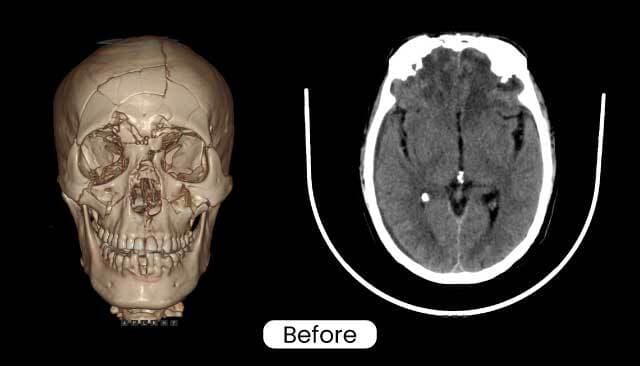
- Bilateral frontal contusions with intracranial hemorrhage
- Rib fractures with surgical emphysema
- Pulmonary contusions with aspiration-related lung changes
- Cervical spine injury involving the C7 spinous process
Managing simultaneous neurological, respiratory, orthopedic, and facial injuries required rapid diagnosis, continuous monitoring, and coordinated multidisciplinary care.
The Approach:
Under the expert supervision of Dr Arindom Kakati, an immediate trauma management protocol was initiated.
The patient underwent:
- Emergency stabilization and ICU monitoring
- Serial CT imaging of the brain, thorax, face, temporal bone, and cervical spine
- Continuous neurological assessment
- Respiratory support and infection management
- Conservative neurosurgical management with close observation
- Multidisciplinary coordination involving Neurosurgery, Maxillofacial Surgery, Ophthalmology, and Internal Medicine teams
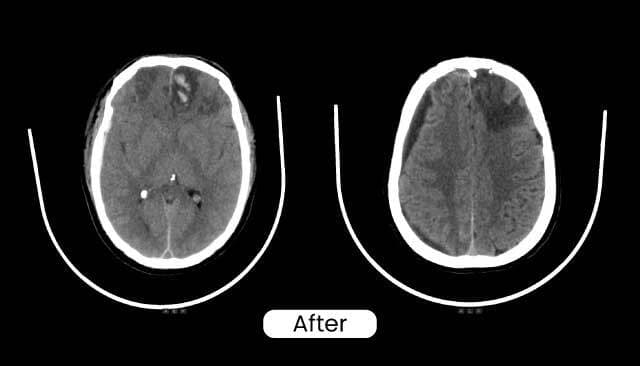
Repeat imaging and close clinical monitoring were performed regularly to evaluate the progression and resolution of intracranial bleeding and pulmonary complications.
The Diagnosis:
Detailed investigations revealed multiple complex injuries, including:
Craniofacial & Neurological Injuries
- Extradural hematoma (EDH) over bilateral frontal regions
- Thin acute subdural hematoma (SDH)
- Bilateral frontal lobe hemorrhagic contusions with cerebral edema
- Multiple fractures involving the frontal bone, orbital walls, zygomatic arches, maxillary walls, nasal bones, hard palate, and cribriform plate
- Bilateral Le Fort fractures
- Residual right frontal extra-axial collection on follow-up imaging
Thoracic Injuries
- Bilateral first rib fractures
- Pulmonary contusions with patchy lung opacities
- Ground-glass lung opacities with mild pleural effusion
- Surgical emphysema with mild pneumomediastinum
Cervical Spine Findings
- Non-displaced fracture of the posterior spinous process of the C7 vertebra
- Straightening of cervical spine curvature with associated soft tissue emphysema
The Solution: Surgical Intervention & Treatment
The patient underwent comprehensive conservative trauma management, including:
- Intensive neurological observation
- Broad-spectrum antibiotics and supportive care
- Respiratory management for pulmonary complications
- Serial CT monitoring to track resolution of intracranial hemorrhage
- Multidisciplinary consultations for craniofacial and cervical spine injuries
- Rehabilitation planning and follow-up care
As follow-up imaging demonstrated gradual clinical improvement, no immediate neurosurgical intervention was required.

The Outcome: Recovery & Stabilisation
During the course of hospitalization:
- Intracranial hematomas and cerebral edema reduced significantly
- Lung opacities and pleural effusions improved steadily
- Neurological status stabilized
- Facial swelling and respiratory distress gradually subsided
The patient showed remarkable recovery, became clinically stable, and was discharged with advice for rehabilitation and scheduled follow-up care.